Designed & manufactured in Herefordshire, UK — shipping worldwide Mon–Thu 9–5 | Fri 9–4 | +44 (0)1981 241668

Vetted power generation units, portable energy storage systems, and hybrid trailers configured for Korea’s rugged topography and harsh marine environments.
South Korea’s commitment to achieving carbon neutrality by 2050, combined with the stringent execution of the K-RE100 initiative and the 10th Basic Plan for Electricity Supply and Demand, has accelerated a paradigm shift toward distributed energy resources (DER). Industrial complexes in Gyeonggi-do, offshore aquaculture developments in Jeollanam-do, and telecommunication microgrids across Gangwon-do's mountain ranges face a unified challenge: grid instability, high demand charges, and harsh localized microclimates.
Micro turbines—ranging from horizontal axis wind turbines (HAWT) to specialized vertical axis systems (VAWT)—represent the critical missing link in Korea’s off-grid and edge-of-grid infrastructure. When paired with solar PV and lithium/AGM energy storage, micro wind power eliminates winter solar generation troughs and delivers continuous operational uptime for industrial specifiers.
Engineered to overcome geographical terrain barriers, salt fog degradation, and seasonal extreme climate variations unique to the Korean peninsula.
Jeju’s intense wind regime yields exceptional capacity factors but subjects hardware to extreme salt air and severe typhoons (e.g., Typhoon Hinnamnor). Micro turbines engineered with C5-M anodized aluminum housings, sealed neodymium permanent magnet generators (PMSG), and automated mechanical disc braking protect infrastructure powering remote oceanographic telemetry, lighthouse relay stations, and offshore aquaculture cages in the Korea Strait.
South Korea’s mountainous spine experiences heavy winter snowfall and reduced solar insolation from November through February. Deploying ultra-low cut-in speed micro turbines (2.0–2.5 m/s) alongside solar arrays ensures 5G cellular repeaters, military radar posts, and weather monitoring stations in Taebaek and Seoraksan maintain constant 24 V / 48 V DC busbar stability without requiring expensive emergency diesel refueling runs up icy mountain passes.
High-tech manufacturing hubs demand zero voltage sags and continuous auxiliary power for environmental sensors, security surveillance, and outdoor autonomous logistics hubs. Compact vertical axis micro wind turbines mounted on industrial facility rooftops capture turbulent urban updrafts, providing supplemental clean energy that helps Korean export enterprises satisfy strict Scope 1 & 2 carbon audit requirements under K-RE100.
From precise CFD aerodynamic blade modeling to ISO 9001 factory assembly, our micro wind turbines and integrated hybrid power systems deliver proven long-term ROI.
Constructed from glass-reinforced nylon or precision carbon-fiber composites, turbine blades utilize advanced quiet-airfoil geometries. This reduces aerodynamic tip vortex noise below 45 dBA at 10 meters, fully complying with South Korea’s strict industrial and residential environmental noise control regulations (KS C 8570 standards).
By eliminating failure-prone mechanical gearboxes, our micro turbines feature heavy-duty direct-drive radial flux PMSGs with rare-earth NdFeB magnets. This gearless configuration dramatically reduces maintenance intervals, allowing up to 5 years of continuous unattended operation in remote locations.
Before equipment deployment, our engineering group utilizes ERA5 meteorological reanalysis dataset blending with the Global Wind Atlas. We execute site-specific simulations mapping 10-year historic wind velocities, thermal updrafts, and solar radiance curves for your exact GPS coordinates in South Korea to guarantee zero-down-time battery autonomy sizing.
Equipped with intelligent maximum power point tracking (MPPT) algorithms optimized for micro-wind curve responses, our controllers convert rapid wind gusts into usable battery charge efficiency up to 98.5%. Built-in RS485 / Modbus / CANbus protocols integrate directly into modern Korean IoT telemetry stacks.
Analyzing operational performance across diverse off-grid power generation architectures in Korean climate conditions.
| Performance Metric | Micro Wind Turbine System | Solar PV Only System | Hybrid Wind-Solar + LiFePO4 | Diesel Generator Backup |
|---|---|---|---|---|
| Winter Performance (Korea) | High (Strong Winter Winds) | Low (Short Days / Snow Cover) | Optimal (Continuous 24/7) | Moderate (Cold Start Risks) |
| Typhoon Resistance | Tested to 27–60 m/s (Auto-Brake) | High Wind Lift Risk on Racks | Engineered Heavy-Duty Racking | Protected in Enclosure |
| Maintenance Cycle | 3 to 5 Years Unattended | Clean Panels Every 6 Months | 3 to 5 Years Integrated | High (Oil/Filters every 250h) |
| K-RE100 Compliance | 100% Zero-Emission | 100% Zero-Emission | 100% Zero-Emission | Non-Compliant (CO2 Output) |
| Noise Level (at 10m) | < 45 dBA (Silent Blade Design) | 0 dBA (Silent) | < 45 dBA (Silent Operation) | 75–90 dBA (Loud Noise Pollution) |
| Levelized Cost of Energy (LCOE) | Low - Medium | Low | Lowest (Long-Term Lifespan) | Extremely High (Fuel Logistics) |
Direct answers covering KC certification, import logistics, installation standards, and custom manufacturing specs.
Yes. Electrical components including hybrid MPPT controllers, grid-tie inverters, and battery management systems (BMS) must comply with National Radio Research Agency (RRA) EMC requirements and KC Safety Certification standards. Our manufacturing facilities work directly with certified Korean testing labs to provide equipment pre-configured with required CE, IEC 61400-2 (Small Wind Turbines), and KC documentation for seamless customs clearance.
Our micro wind turbines utilize a dual passive/active braking system. When wind velocities exceed rated operating thresholds (typically 15–20 m/s), aerodynamic pitch control automatically feathers the blades to minimize drag. In storm-force conditions above 25 m/s (56 mph), electromagnetic dynamic braking activates via the controller, short-circuiting generator coils to stop rotor rotation completely. All structural mounts are FEA-tested to survive wind gusts up to 60 m/s (134 mph).
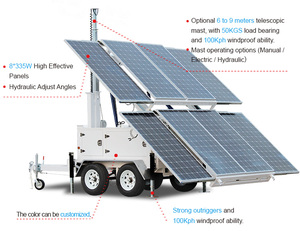
Our mobile hybrid solar/wind trailers (4KW/5KW) arrive as complete turn-key units housed in weather-resistant IP65 powder-coated steel enclosures. Korean clients can specify custom internal DIN rails, 12V/24V/48V DC busbars, 220V single-phase pure sine wave AC inverters, and integrated 4G/5G/Starlink telemetry gear. Systems can be set up and commissioned by field technicians in under 45 minutes without requiring heavy cranes.
Absolutely. Every standard system features native RS485 communication supporting open Modbus RTU / TCP protocols. Real-time telemetry monitoring provides visibility into state of charge (SoC), instantaneous wind turbine RPM, PV voltage, temperature, and load consumption metrics. System data can be pushed directly to local PLC controllers, Korean industrial SCADA networks, or cloud dashboards.
For installations in Gangwon-do or high-altitude sites where winter temperatures drop below -20°C, we recommend either low-temperature premium LiFePO4 cells with built-in internal thermal heating pads or heavy-duty sealed Deep-Cycle AGM batteries. Deep-cycle AGM batteries maintain reliable discharge profiles down to sub-zero temperatures without requiring active thermal management, making them an ultra-reliable choice for unattended telemetry posts.
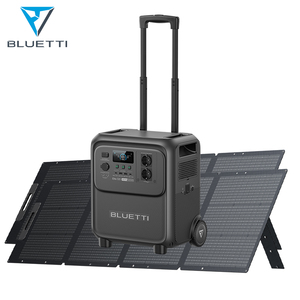
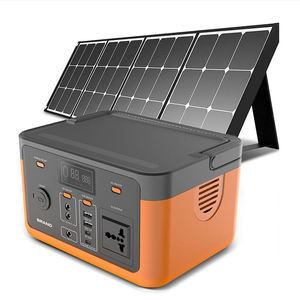
Standard product lines (such as portable power generators and standard 300W–5kW micro turbines) are maintained in stock for rapid export dispatch within 7–10 business days. Custom bespoke engineered microgrid containers or high-capacity hybrid trailers typically carry a 4–6 week production lead time. Cargo is ocean-shipped in standard FCL/LCL containers directly to Busan Port or Incheon Port with full commercial invoicing, HS Code classification, and origin documentation.
Whether you require a single marine-grade micro turbine sample, an OEM build, or a full fleet of hybrid power trailers for nationwide distribution across South Korea, our engineering team is standing by to assist with resource modeling, CAD drawings, and factory direct pricing.